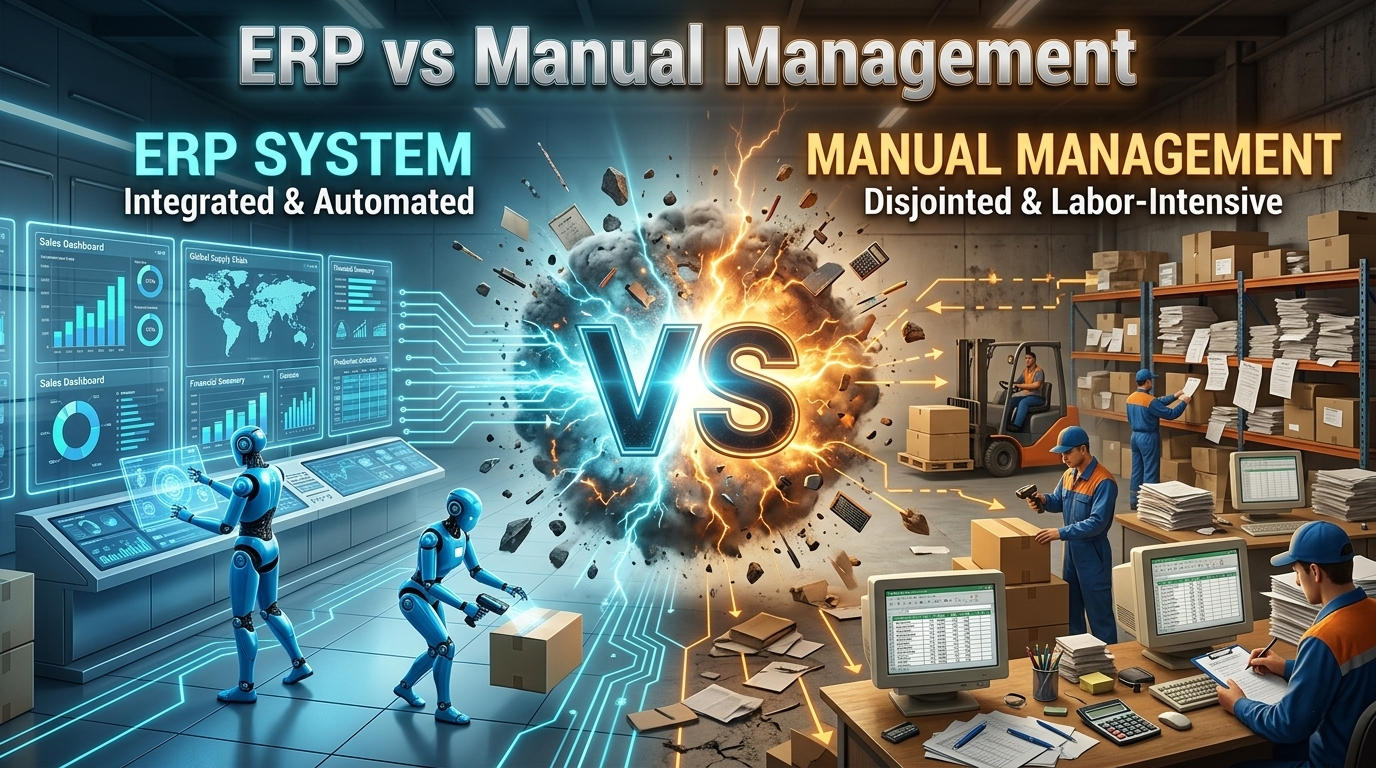
As ecommerce businesses in Singapore continue growing across Shopee, Lazada, TikTok Shop, Shopify, webstores, and retail stores, managing operations manually is becoming increasingly difficult.
Many ecommerce sellers still rely on spreadsheets, manual stock updates, separate courier portals, handwritten workflows, and disconnected systems to manage daily operations. While manual management may still work during the early stage of business, operational complexity increases rapidly once order volume starts growing.
As businesses expand into multichannel selling, sellers are required to coordinate inventory, fulfillment, reporting, customer enquiries, payment reconciliation, and warehouse operations across multiple platforms at the same time. Managing these workflows manually often creates inefficiencies that slow down daily operations and make backend coordination harder to control.
In this article, we will explain ERP vs manual management, the operational problems caused by disconnected workflows, and why more ecommerce sellers in Singapore are adopting ecommerce ERP systems in 2026.
What is Manual Management in Ecommerce?
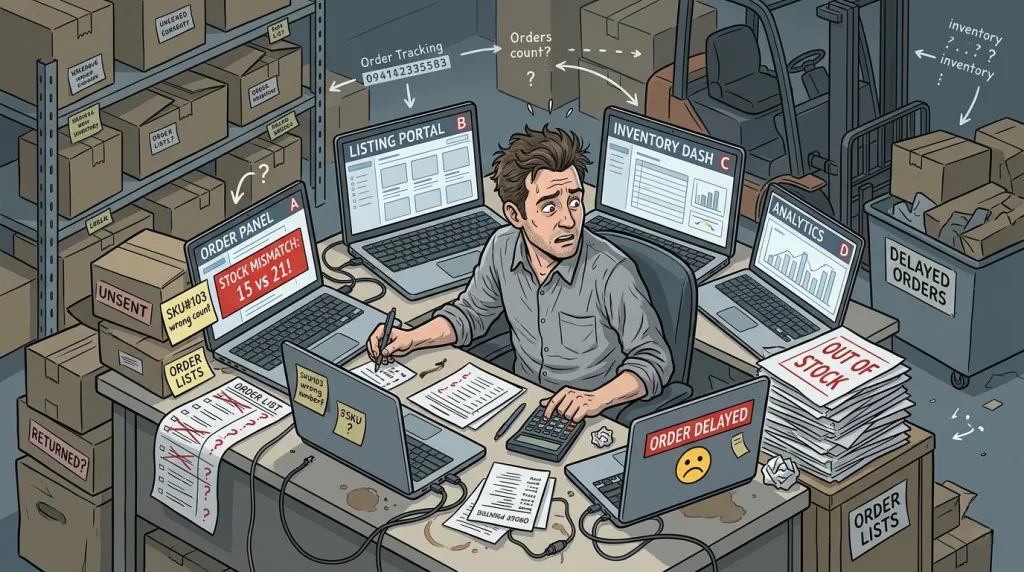
Manual management refers to handling ecommerce operations using spreadsheets, separate systems, manual coordination, and repetitive human processes without centralized automation.
In many cases, ecommerce sellers begin their business using manual workflows because they are simple and easy to manage at an early stage. However, as the business grows and operations become more complex, these manual processes quickly become inefficient and difficult to scale.
In a typical manual setup, sellers often manage inventory updates, order processing, warehouse coordination, and fulfillment activities across multiple platforms separately. Stock quantities may need to be updated manually across different marketplaces, while orders are processed one platform at a time. Inventory is commonly tracked using spreadsheets, and warehouse operations rely heavily on manual coordination and printed documents.
Shipping and fulfillment tasks are also handled individually, where shipping labels are printed one by one and tracking numbers are manually copied into different systems. In addition, some sellers still perform manual payment reconciliation and repetitive data entry across multiple tools, which increases operational workload and the risk of human error.
Common examples of manual ecommerce management include managing Shopee and Lazada inventory separately, checking orders marketplace by marketplace, using Excel spreadsheets for stock tracking, manually syncing online and offline inventory, and handling courier bookings individually. During high order volume periods, delays in stock updates and manual payout checking can further slow down overall operations.
While this approach may still be manageable for small-scale businesses, it becomes increasingly unsustainable as ecommerce sellers expand across multiple channels and experience higher daily order volume.
What is an Ecommerce ERP System?
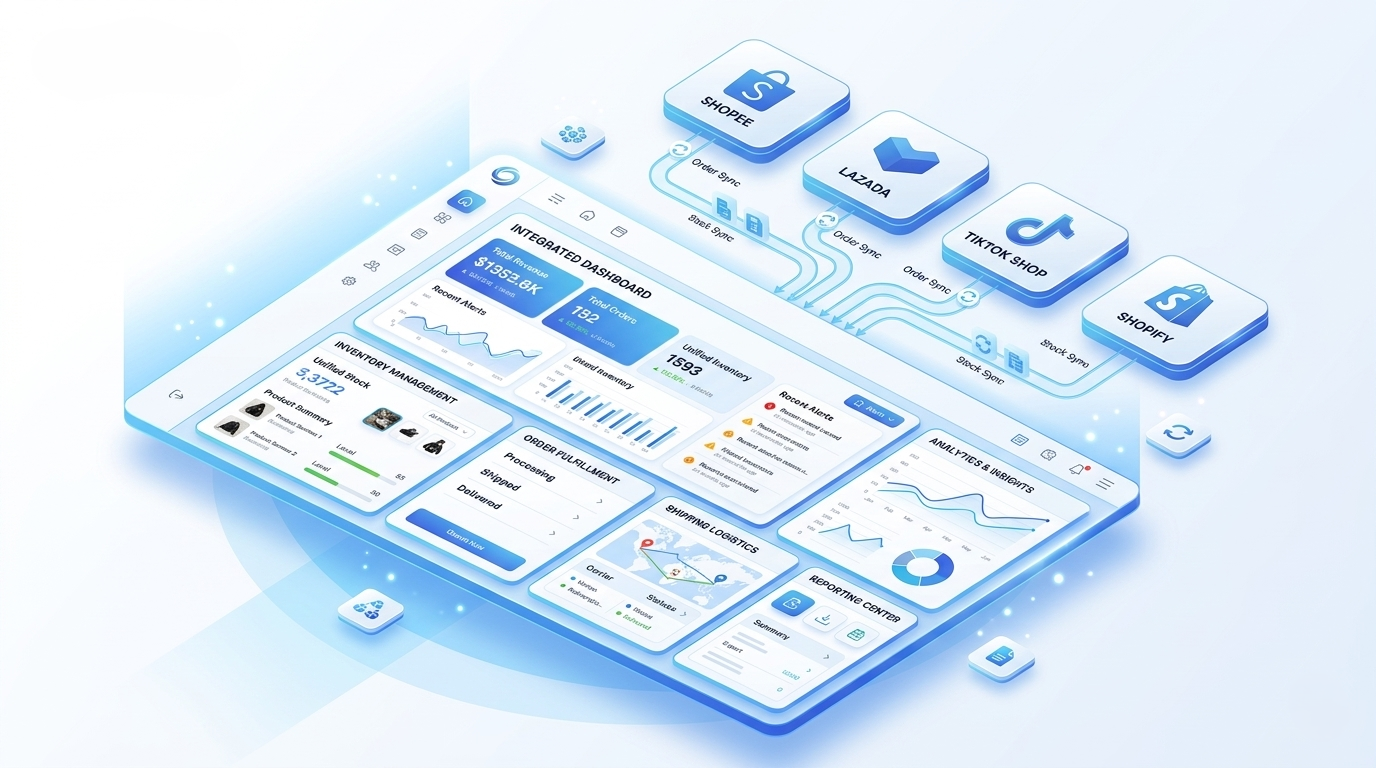
An ecommerce ERP system is a centralized management platform that connects all key ecommerce operations into a single unified system, including inventory, orders, fulfillment, reporting, customer enquiries, and marketplace operations.
Instead of managing multiple disconnected tools separately, ecommerce sellers are able to operate their entire business from one centralized dashboard. This helps businesses move away from fragmented workflows and manual coordination, and transition towards a more structured, automated, and scalable operational model.
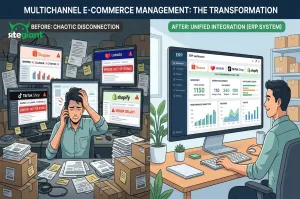
Unlike manual management, where different teams rely on spreadsheets, separate systems, and individual platform dashboards, an ecommerce ERP system provides centralized visibility across the entire ecommerce workflow. This allows business owners to monitor and manage operations more efficiently, with better control over inventory, orders, and fulfillment processes.
Core Functions of an Ecommerce ERP System
Modern ecommerce ERP systems typically include:
- Multichannel order management
- Real-time inventory synchronization
- Marketplace integration
- Shipping and courier integration
- Centralized reporting dashboard
- Product management across channels
- Payment reconciliation support
- Customer enquiry management
- Online and offline inventory synchronization
- Operational workflow coordination
- Order fulfillment assistance
- Accounting system integration
For ecommerce sellers operating across Shopee, Lazada, TikTok Shop, Shopify, retail POS systems, and webstores, an ERP system plays a critical role in unifying backend operations into one connected ecosystem, improving efficiency and reducing operational complexity.
Why Manual Management Becomes a Problem as Ecommerce Businesses Grow?
1. Manual Picking & Visual Checking
In the early stage of an ecommerce business, many sellers are able to manage operations manually using spreadsheets, separate dashboards, and simple workflows. At this stage, order volume is usually manageable, and manual coordination is still practical for daily operations.
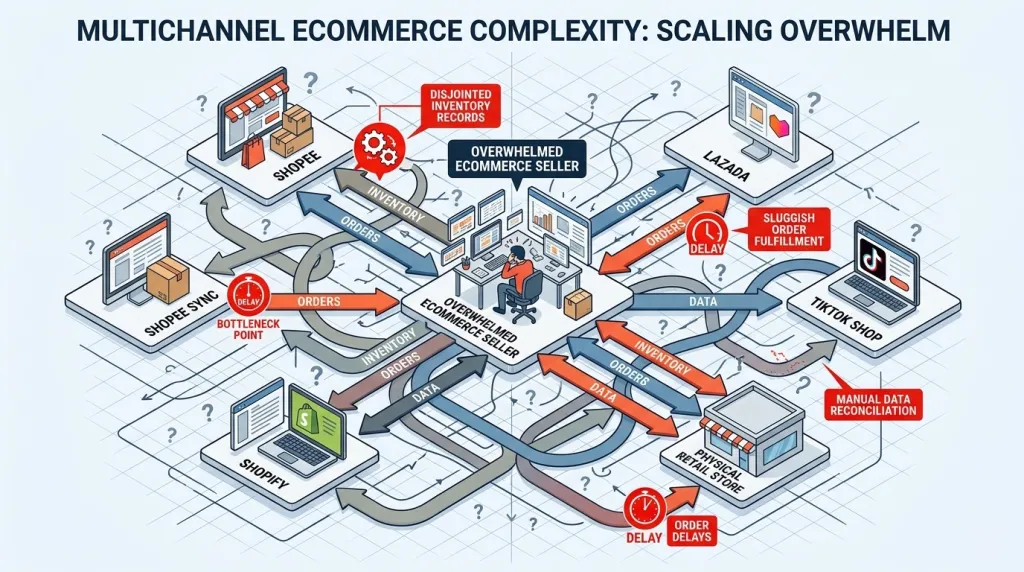
However, as businesses expand across multiple sales channels and order volume increases, manual processes quickly become more difficult to manage efficiently. What once worked for around 20 orders per day can quickly become overwhelming when businesses start handling hundreds of daily orders across multiple ecommerce marketplaces.
At this stage, sellers are required to manage inventory, fulfillment, warehouse coordination, and customer enquiries simultaneously across different platforms. This increases operational workload significantly, and sellers often find themselves spending more time on backend coordination rather than focusing on business growth. Over time, this creates operational bottlenecks that limit scalability and reduce overall efficiency.
Why this Happens: Fragmented Manual Systems
The main reason manual management becomes difficult at scale is because ecommerce operations are typically handled using disconnected systems that do not work together in an integrated environment.
In most manual setups, different business functions are managed separately across multiple tools such as marketplace dashboards like Shopee, Lazada, and TikTok Shop, courier and shipping portals, accounting software, POS systems for offline retail, and spreadsheets for inventory tracking and reporting.
Because these systems are not integrated, data needs to be manually updated across different platforms. This creates inefficiencies in daily operations, increases workload, and reduces operational accuracy.
As a result, businesses often experience delayed inventory synchronization between channels, stock mismatch across marketplaces, higher risk of human error, slower warehouse coordination, and limited real-time visibility of overall business performance.
During peak sales periods, when order volume increases rapidly and operational pressure intensifies, these issues become even more severe and can significantly affect fulfillment speed, accuracy, and customer satisfaction.
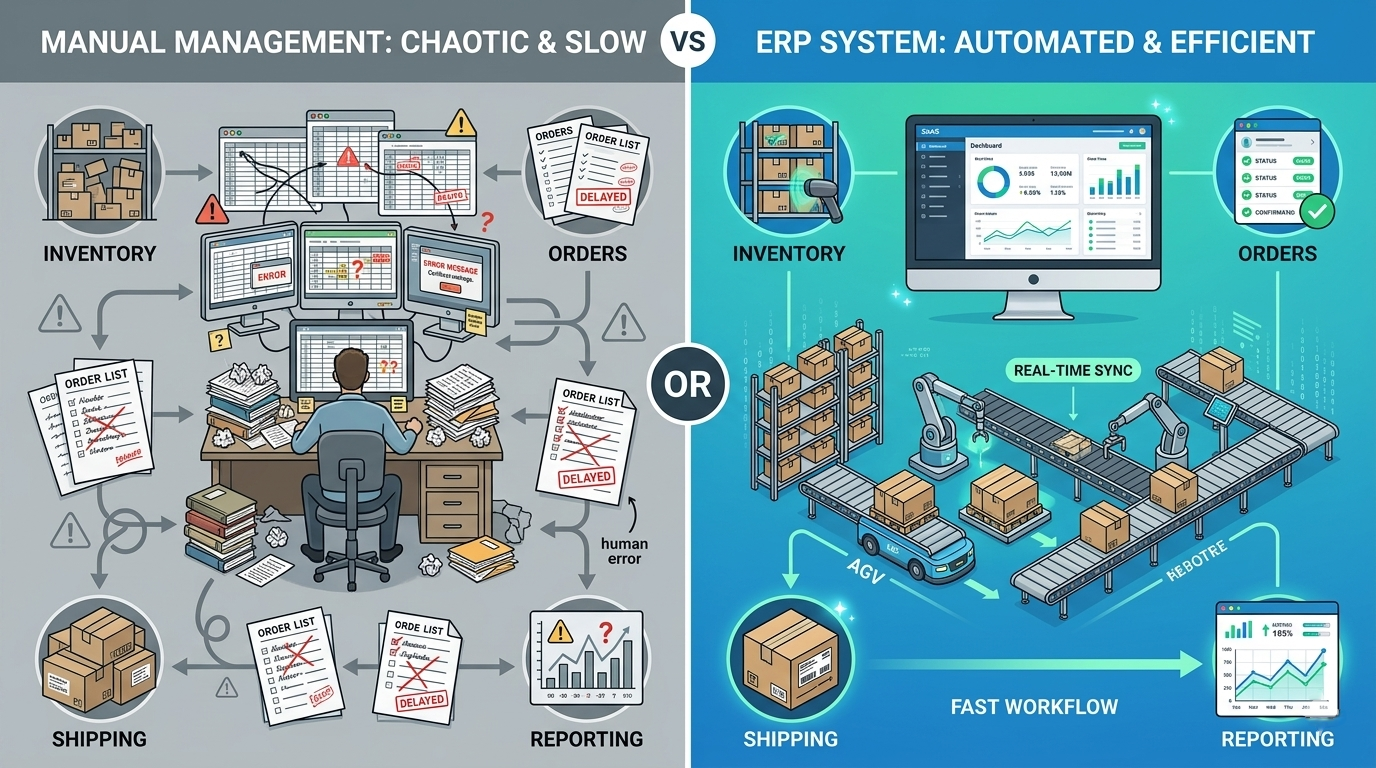
ERP vs Manual Management: Key Differences
| Area | Manual Management | Ecommerce ERP System |
| Inventory Updates | Manual Excel updates | Real-time synchronization |
| Order Processing | Platform by platform | Centralized dashboard |
| Reporting | Spreadsheet-based | Automated reporting |
| Risk of Overselling | High | Low |
| Operational Efficiency | Low | High |
| Scalability | Limited | Strong |
Why Ecommerce Sellers Are Using an Ecommerce ERP System?
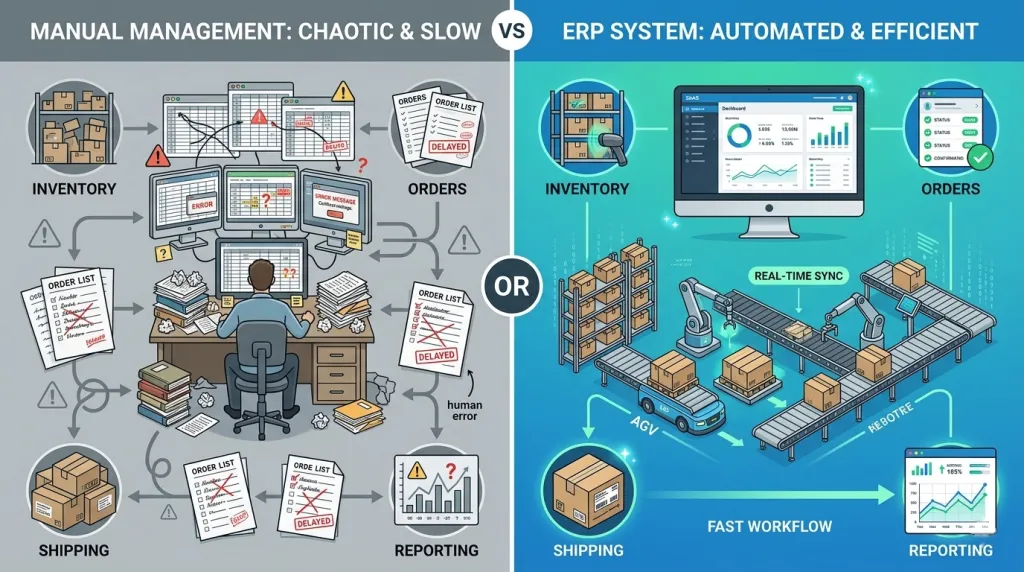
As ecommerce businesses grow, operational complexity increases rapidly across multiple sales channels. This is why sellers adopt ERP systems to improve efficiency and reduce manual workload.
A. Managing Multiple Channels Efficiently
As sellers expand across multiple platforms, managing operations separately becomes inefficient and time-consuming. An ecommerce ERP system allows centralized management across Shopee, Lazada, TikTok Shop, and Shopify, making cross-platform operations more structured and easier to control.
- Centralized Shopee, Lazada, TikTok Shop, Shopify management
- Faster cross-platform coordination
- Better control across channels
B. Reducing Repetitive Manual Work
Manual ecommerce operations often involve repetitive tasks that slow down daily workflows. ERP systems help automate these processes, reducing workload and improving operational efficiency across key backend functions.
- Stock updates automation
- Order checking simplification
- Tracking number automation
- Reporting automation
C. Improving Inventory Visibility
One of the key advantages of an ecommerce ERP system is real-time inventory synchronization. This ensures that stock levels are accurately reflected across all sales channels, reducing operational risks.
- Real-time stock sync
- Reduced stock mismatch
- Prevention of overselling
D. Simplifying Payment Reconciliation
As order volume increases, tracking marketplace payouts manually becomes complex and time-consuming. ERP systems simplify this process by providing centralized financial visibility across platforms.
- Easier payout tracking
- Better financial visibility
- Reduced manual reconciliation work
E. Managing Online & Offline Inventory Together
For sellers operating both ecommerce stores and physical retail outlets, inventory management becomes more complex without a centralized system. ERP helps unify inventory across all channels to maintain consistency.
- Unified inventory system
- Reduced discrepancies
- Better stock consistency
F. Improving Operational Visibility
ERP systems provide clearer visibility into overall business performance by consolidating key operational data into one system. This helps sellers make better decisions based on real-time insights.
- Sales performance tracking
- Inventory movement monitoring
- Marketplace performance analysis
- Fulfillment insights
G. Supporting Campaign Periods
During high-demand sales periods, operational efficiency becomes critical. ERP systems help businesses maintain stability and speed during peak order volume periods such as 11.11 and 12.12.
- Faster order processing
- Better warehouse coordination
- Stable performance during 11.11 / 12.12
Sign Your Ecommerce Business Has Outgrown Manual Management
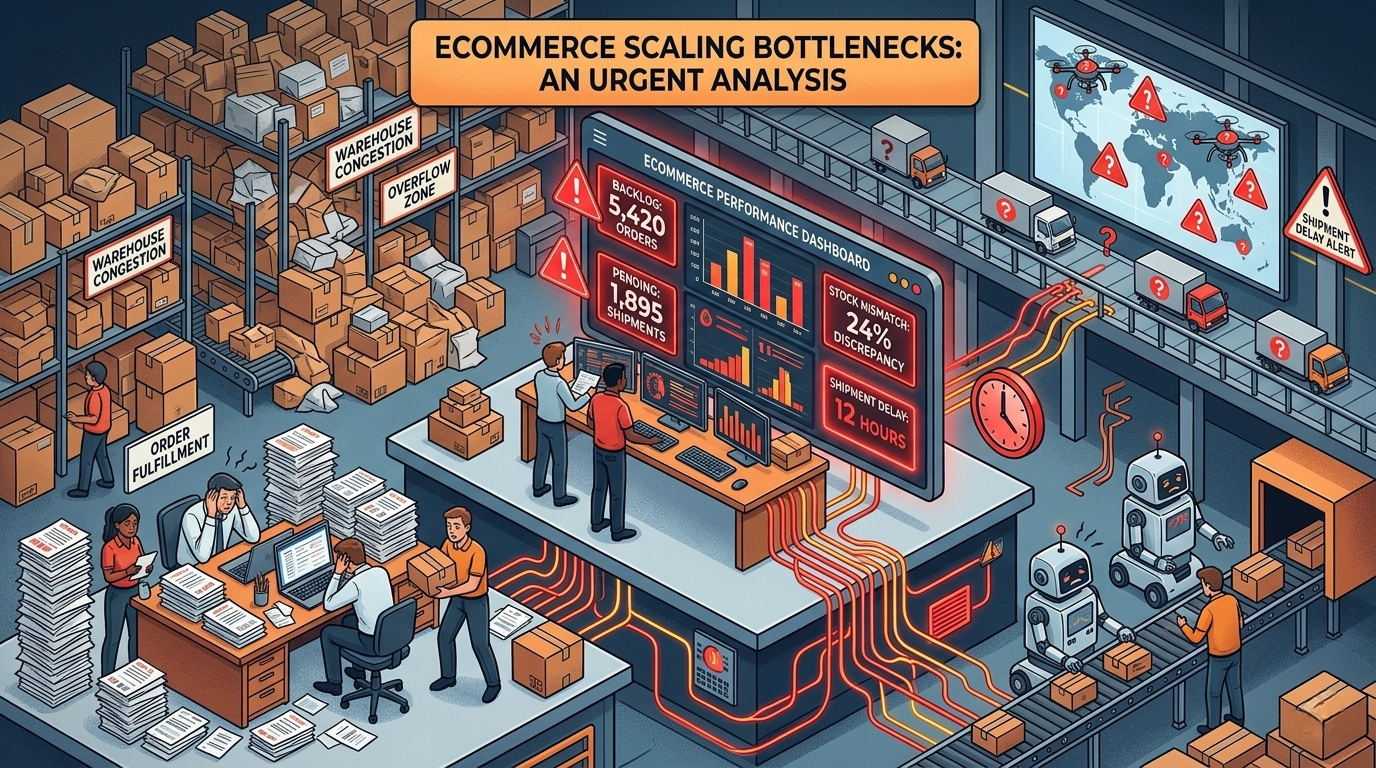
As ecommerce operations become more complex, many sellers may not immediately realize that their current manual workflows are no longer sufficient. Over time, inefficiencies start to accumulate, affecting daily operations, order accuracy, and overall business scalability. If your ecommerce business is experiencing increasing operational pressure, it may be a sign that you have outgrown manual management and require a more centralized system such as an ecommerce ERP system.
Your business may need an ecommerce ERP system if:
- Daily orders are increasing rapidly
- Staff spend too much time on repetitive tasks
- Inventory mismatch happens frequently
- Overselling occurs during campaigns
- Reporting becomes difficult to manage
- Multiple marketplaces become hard to coordinate
- Customer enquiries are difficult to monitor
- Operational bottlenecks are slowing fulfillment
- Backend workflows become increasingly complicated
How SiteGiant ERP Supports Ecommerce in Singapore?
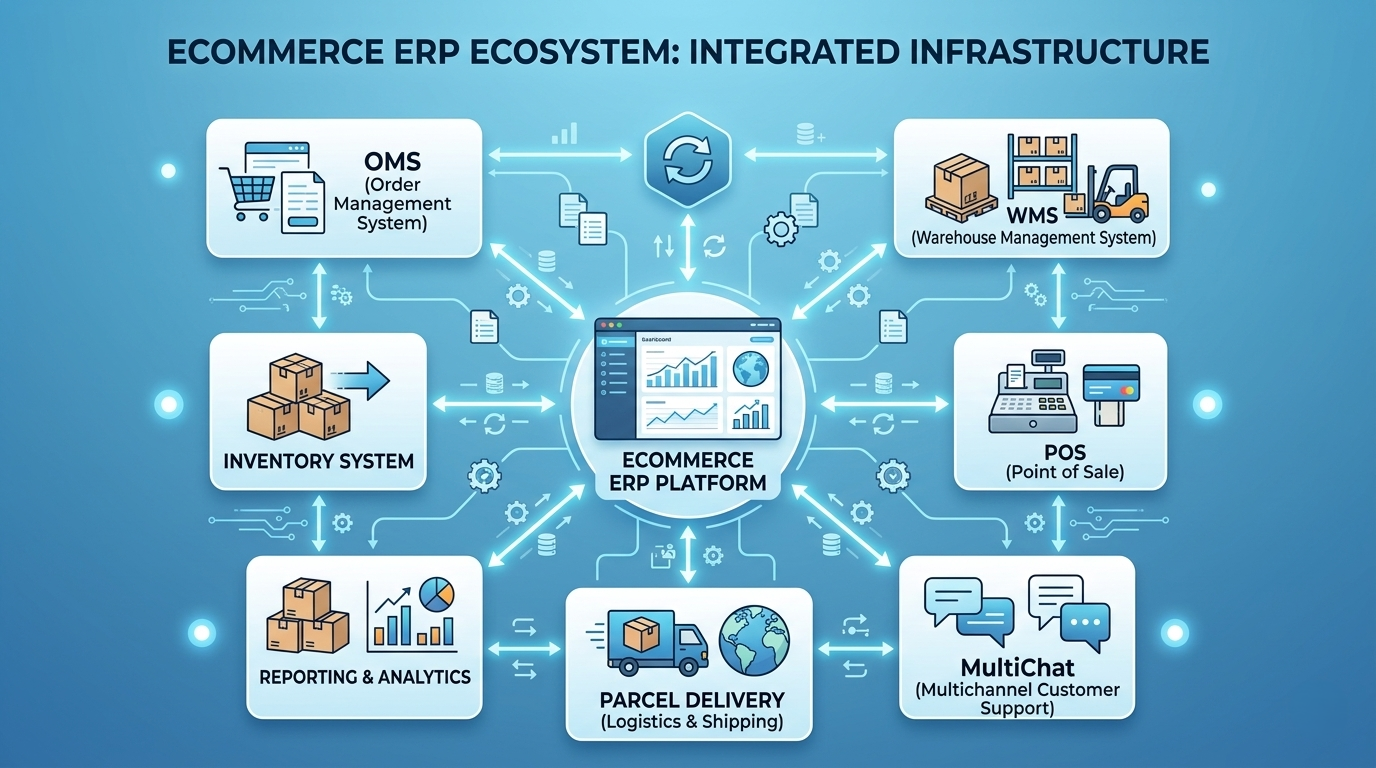
SiteGiant ERP is designed specifically for Singaporean ecommerce sellers managing multichannel operations across marketplaces and retail channels.
Instead of relying on spreadsheets and disconnected systems, sellers can centralize their entire ecommerce operation into one connected platform.
Key capabilities include:
- Centralized multichannel order management
- Real-time inventory synchronization
- Unified product management across channels
- Integrated warehouse and fulfillment workflow
- Online and offline inventory coordination
- Payment and settlement reconciliation
- Customer enquiry management across platforms
- Real-time reporting and operational tracking
SiteGiant also provides an integrated ecommerce ecosystem that includes ERP, OMS, WMS, POS, MultiChat, ParcelGuard, and 50+ integrations to support growing ecommerce businesses in Singapore.
By eliminating fragmented workflows, SiteGiant ERP helps ecommerce sellers reduce manual workload, improve operational accuracy, and scale more efficiently.
Frequently Asked Questions (FAQ)
What is the difference between ecommerce ERP system and manual management?
Manual management relies on spreadsheets, disconnected tools, and manual updates across multiple platforms. In contrast, an ecommerce ERP system centralizes inventory, orders, reporting, and operations into one unified dashboard.
Why do ecommerce sellers switch from manual management to ERP systems?
Ecommerce sellers switch to ERP systems because manual workflows become inefficient, error-prone, and difficult to scale when managing multiple marketplaces such as Shopee, Lazada, and TikTok Shop.
How does an ecommerce ERP system help prevent overselling?
An ERP system provides real-time inventory synchronization across all sales channels, reducing stock mismatch and preventing overselling during high-demand periods.
Is ecommerce ERP suitable for small and medium businesses (SMEs)?
Yes. Errors like late shipments, incorrect orders, and cancellations can lower seller ratings, reduce visibility, and lead to penalties on platforms like Shopee and Lazada.
How does ERP improve multichannel ecommerce operations?
ERP systems help sellers streamline multichannel order management, automate inventory updates, and improve coordination across different sales platforms.
Why is manual ecommerce management risky during campaign sales?
During peak campaigns like 11.11 or 12.12, manual systems struggle to handle high order volume, leading to delays, stock mismatch, and fulfillment errors.
Conclusion
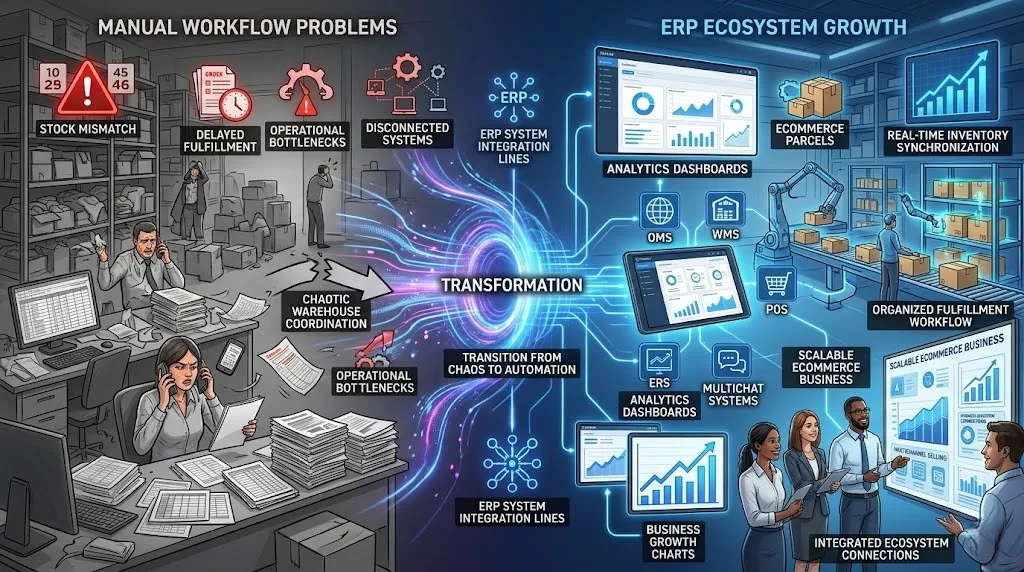
As ecommerce businesses expand across multiple marketplaces, webstores, and retail channels, relying on disconnected manual workflows becomes increasingly difficult to sustain.
What once worked during the early stage of business can eventually create operational bottlenecks, repetitive manual work, inventory mismatch, delayed coordination, and limited operational visibility.
That is why more ecommerce sellers in Singapore are switching to ecommerce ERP systems to centralize operations, simplify multichannel management, improve inventory visibility, and reduce dependency on manual processes.
With integrated solutions including ERP, OMS, WMS, POS, MultiChat, payment reconciliation support, and 50+ integrations, SiteGiant ERP helps ecommerce sellers streamline backend operations more efficiently.
Because in today’s competitive ecommerce landscape, businesses that continue relying heavily on disconnected manual workflows will eventually face scaling limitations.
The sellers that grow more efficiently are the ones building centralized operational systems that support long-term ecommerce growth.