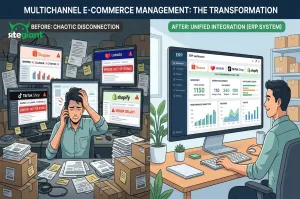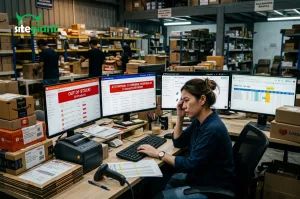
- Selling on multiple channels without proper synchronization
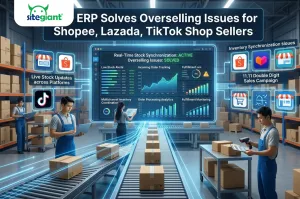
- Overselling or stockouts due to poor inventory management
- Repetitive manual tasks such as updating stock and processing orders
- Order mistakes and shipping delays that frustrate customers
- High operating costs from inefficient workflows
- Strict marketplace policies that limit branding and customer relationships
- Limited visibility into overall performance
What is an ERP System?
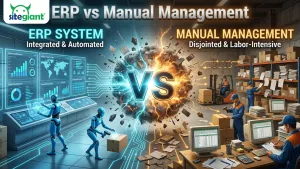
An ERP (Enterprise Resource Planning) system is a comprehensive platform that enables e-commerce businesses to manage their daily operations efficiently. It integrates essential functions, including inventory, orders, sales, purchasing, accounting, and reporting, into a centralised system.

- Syncing stock across multiple marketplaces
- Automating order processing
- Tracking payments and invoices
- Generating real-time business reports
Benefits of Having an eCommerce ERP System

Adopting an ERP solution can transform the way an online business operates. The key benefits include:
- Centralized operations – An ERP system connects sales, inventory, accounting, purchasing, and customer data on a single platform, so you don’t have to switch between multiple tools or spreadsheets.
- Multichannel support – Sell smarter by syncing inventory and orders across Shopee, Lazada, TikTok Shop, webstores, and even offline POS. With real-time updates, sellers can avoid overselling, fulfill orders faster, and maintain consistent stock accuracy across all sales channels.
- Automation of manual tasks – Eliminate repetitive work like data entry, order updates, and stock adjustments. Automation minimizes human error and gives your team more time to focus on marketing, customer service, and growth.
- Cost efficiency – Reduce operating expenses by streamlining workflows and minimizing labor-intensive processes. With better control over inventory and purchasing, businesses can cut unnecessary costs and improve profit margins.
- Adaptability to policies – Keep your business compliant with marketplace policies and government regulations. ERP also allows you to maintain control over your branding and customer relationships.
- Better decision-making – Make smarter business moves with real-time insights. ERP systems provide detailed sales, stock, and financial reports that help you identify trends, forecast demand, and plan strategically for growth.
Top 10 ERP Software Systems in Singapore 2025
1. SiteGiant ERP
It streamlines your entire retail and e-commerce workflow in one platform. Sellers can manage inventory in real time across online stores and physical outlets, automate order syncing, track fulfillment, and generate accurate financial and sales reports in a single dashboard. Reducing manual work, increasing efficiency.

2. Acumatica
Acumatica ERP is a cloud-based business management software designed for growing companies. It helps manage finance, inventory, sales, and operations in one connected system. Most of its customers are based in the United States. The company operates through a network of global partners that provide localization and industry-specific solutions.
3. Oracle NetSuite
It is a global cloud ERP that automates core processes and provides real-time visibility into finance, inventory, supply chain, and operations. It supports multiple subsidiaries and business units, making it ideal for enterprises with regional or global reach. While powerful and scalable, its complexity and cost may be less suitable for smaller businesses.

4. Sage
An ERP and accounting software provider. It offers strong features in finance, payroll, HR, and inventory management, paired with an easy-to-use interface that makes it accessible to non-technical users. Sage is valued for its affordability and reliability, though it may lack the advanced customization and scalability required by larger enterprises.

5. Microsoft Dynamics 365
Microsoft Dynamics 365 combines ERP and CRM capabilities in one platform, offering tools for finance, sales, customer service, supply chain, and operations. Its integration with Microsoft’s ecosystem, including Office 365, Power BI, and Azure, is suitable for businesses already using Microsoft products. However, its setup and licensing can be complex, which may be a hurdle for smaller businesses.
6. ECOUNT
A Korean cloud-based ERP solution is widely adopted by SMEs across Asia. It offers essential modules for accounting, inventory, sales, purchasing, and production, all accessible online at a highly affordable price. Its cost-effectiveness makes ERP accessible to smaller businesses, though it may lack the deep customization and advanced integrations needed by larger enterprises.

7. SAP Business One
It is a globally trusted ERP solution that provides robust features for finance, inventory, sales, purchasing, and production management, with strong reporting and analytics. While highly reliable and scalable, it often requires higher implementation costs and technical expertise.
8. Epicor ERP
Epicor ERP is well-regarded for its strength in manufacturing, distribution, and supply chain management. It offers robust automation tools that help businesses streamline production, inventory, and order fulfillment processes. While powerful for industry-specific needs, its implementation can be complex.

9. Odoo
Odoo is a popular open-source ERP known for its wide range of customizable modules, covering everything from sales and CRM to inventory, HR, and accounting. It allows businesses to tailor the system to their unique workflows. However, customization and third-party apps may require technical expertise, which can add to the overall cost and complexity.

10. Infor ERP

Comparison of ERP Software Systems in Singapore 2025
| ERP System | Strengths | Weaknesses | Best For |
| SiteGiant ERP | Cloud-based, affordable, comprehensive features, localized with strong marketplace integrations | SME-focused | SMEs or Omnichannel sellers |
| Acumatica | Scalable modules for finance, distribution, and production | Higher cost, complex, limited local presence | Mid-sized businesses needing customization |
| Oracle NetSuite | Global, advanced analytics | Expensive, Complex | Large corporations |
| Sage | Finance & accounting strength | Limited e-commerce support | SMEs needing finance ERP |
| Dynamics 365 | ERP + CRM, integrates with Microsoft | Complex setup | Large corporations |
| ECOUNT | Affordable, Cloud-based | Limited customization & integrations | SMEs in trading, and manufacturing |
| SAP Business One | Enterprise-level features | Costly | Manufacturing & MNCs |
| Epicor ERP | Manufacturing expertise | Limited local support | Manufacturers |
| Odoo | Open-source, flexible | Needs technical expertise | Tech-savvy SMEs |
| Infor ERP | Supply chain strength | Low local presence | Industry-specific firms |
What Are the Key Factors to Consider Before Choosing an ERP System?

Selecting the right ERP system is a crucial decision that can significantly impact your business’s efficiency and growth. With so many solutions available, it’s important to evaluate what truly fits your company’s needs. Here are the key factors to consider before making your choice:
- Business Size & Industry Fit – Ensure the ERP system is designed for your business scale (SME or enterprise) and supports your specific industry requirements.
- Features & Modules – Look for essential modules such as inventory, order, sales, and CRM to cover your core operations.
- Scalability – Choose a system that can grow with your business and support expansion into new sales channels or regions.
- Ease of Use – A user-friendly interface reduces training time and helps your team adapt quickly.
- Integration Capability – The ERP should integrate smoothly with other tools such as e-commerce platforms, POS systems, accounting software, and logistics partners.
- Cloud vs. On-Premise – Cloud ERP offers accessibility, automatic updates, and lower upfront costs, while on-premise systems provide more control and data security.
- Support & Training – Local support, onboarding assistance, and training resources are vital for a successful implementation.
- Cost & ROI – Beyond the price tag, consider long-term value, efficiency gains, and how fast the system can deliver a return on investment.
By evaluating these factors carefully, you can identify the ERP system that best supports your business operations, goals, and future growth.
Why Choose SiteGiant ERP System in Singapore?
Among the many ERP solutions available, SiteGiant ERP stands out as the best choice for Singapore online sellers and SMEs. Unlike global systems that come with high costs and complex implementations, SiteGiant ERP is designed to solve the challenges local sellers face every day.
-
Real-Time Stock Synchronization – Automatically updates inventory across marketplaces, webstores, and POS systems to prevent overselling or stockouts.
-
Faster Order Fulfillment – Streamlines the entire order-to-delivery process, reducing manual entry errors and improving shipping speed. Carrier Manifest allows sellers to cross-check shipments before dispatching, ensuring accurate and timely deliveries.
-
Advanced Reporting & Insights – Access over 15 comprehensive reports that give you a clear overview of your sales, inventory, and financial performance, helping you make smarter, data-driven decisions.
-
Seamless Marketplace & System Integrations – Connects with 50+ integrations, including Shopee, Lazada, TikTok Shop, Shopify, WooCommerce, accounting software, and logistics providers.
-
Local Support & Training – Backed by a dedicated support team, SiteGiant ensures smooth onboarding and responsive after-sales assistance.
-
Omnichannel Scalability – Whether you sell online, offline, or both, SiteGiant ERP grows with your business—keeping data accurate and operations connected across all channels.
Proven Results from Local Sellers
1. Chek Hup
“We only need one employee to process 300 orders within an hour!”
We have been using SiteGiant for more than 3 years. Before we used SiteGiant, our order fulfillment process was quite time-consuming and complicated. During campaign days, we couldn’t fulfill our orders on time, and there were a lot of packing errors. After using SiteGiant ERP system, we now only need one employee to process 300 orders within an hour. The reporting tool is one of my most favourable features in SiteGiant ERP system, we can easily generate the reports and get the data from all platforms we sell on.
2. QSR Trading
“We can track inventory effectively and smoothen order processing, from picking and packing to prompt delivery!"
After adopting SiteGiant ERP, we quickly launched our webstore without any coding required. The system’s real-time inventory tracking has been a game-changer, offering us clear insights into our stock levels. This improvement has significantly streamlined our order fulfillment process, from picking and packing to prompt delivery. SiteGiant ERP delivers exactly what businesses require for efficient operations.
Frequently Asked Questions (FAQ)
Q1: What is the best ERP system for SMEs in Singapore?
Q2: Do small businesses really need ERP software?
Small sellers selling on multiple channels can benefit from ERP by syncing their inventory, preventing overselling, automating tasks, and managing orders more efficiently.
Q3: How much does ERP software cost in Singapore?
Conclusion